Routine11 min read
Sunscreen in Pakistan: SPF, PA rating, and why most local SPFs underperform
A clinical breakdown of what SPF and PA actually mean, why SPF 50 PA++++ is the dermatologist standard for South Asian skin in 2026, and how to apply it correctly.
Sunscreen is the single most important skincare habit anyone with Pakistani skin can build. More impactful than any brightening serum, retinol routine, or pigmentation laser. This isn't aesthetic preference — it's the consensus position of dermatologists across India, Pakistan, and Bangladesh in 2026.
But most people don't know what they're buying. The number on the bottle (SPF 30, SPF 50) is half the story; the symbol next to it (PA+, PA++, PA+++, PA++++) is the other half — and it's the half that matters most for melanin-rich skin.
Here's what each rating means and what to actually buy.
SPF measures UVB. PA measures UVA. They are different rays.
Two kinds of ultraviolet light reach you at ground level:
- UVB is the ray that causes sunburn, the immediate red mark you get after an unprotected hour outside. SPF measures UVB protection.
- UVA is the ray that causes ageing, hyperpigmentation, and collagen breakdown. UVA penetrates clouds, glass, and clothes. PA measures UVA protection.
A bottle labelled "SPF 50" with no PA rating is protecting you against burn but not against pigment. For South Asian skin, where the dominant concerns are dark spots and uneven tone — not burn — that's the wrong half of the protection.
What the numbers actually mean
SPF (UVB protection): - SPF 15 blocks ~93% of UVB - SPF 30 blocks ~97% - SPF 50 blocks ~98% - SPF 100 blocks ~99%
The diminishing returns above SPF 50 are real. SPF 50 vs SPF 100 is a 1% difference, not a 2x difference. The reason dermatologists recommend SPF 50 (not 30) isn't the extra 1% — it's that real-world application is always thinner than the lab dose, so SPF 50 in practice gives you the protection that SPF 30 promises in theory.
PA (UVA protection): - PA+ — some protection - PA++ — moderate - PA+++ — high - PA++++ — very high
For melanin-rich skin where pigmentation is the dominant aesthetic concern, PA++++ is the minimum, not the premium tier.
The 2026 dermatologist standard for Pakistan and India
After years of reviewing the literature on South Asian skin, the consensus across PK/IN dermatologists has converged:
SPF 50, PA++++, applied at 2 mg/cm² of skin, every morning, reapplied every 2 hours of direct sun exposure.
That's the protocol. Anything less and you're treating burn risk while leaving pigment risk wide open.
Why most local SPFs underperform
Three problems with what's typically on Pakistani pharmacy shelves:
- SPF claims without lab verification. The Pakistani regulatory framework for cosmetics doesn't mandate independent SPF testing. A bottle labelled "SPF 50" may test out at SPF 18 in an independent lab.
- No PA rating. Most local sunscreens advertise SPF only and either omit PA entirely or claim "broad-spectrum" without specifying the rating. Broad-spectrum is meaningless without a number.
- White cast. The cheapest UVA filters (older zinc oxide formulations, some titanium dioxide blends) leave a chalky cast on melanin-rich skin. The result: people apply too thin a layer to avoid looking ashen, and SPF efficacy collapses.
This is changing — better-formulated local SPFs are entering the market — but the safer approach for now is to choose carefully and apply correctly.
How to apply it correctly (the part everyone gets wrong)
SPF efficacy is measured at 2 mg per square centimetre of skin. For an average adult face + neck, that translates to:
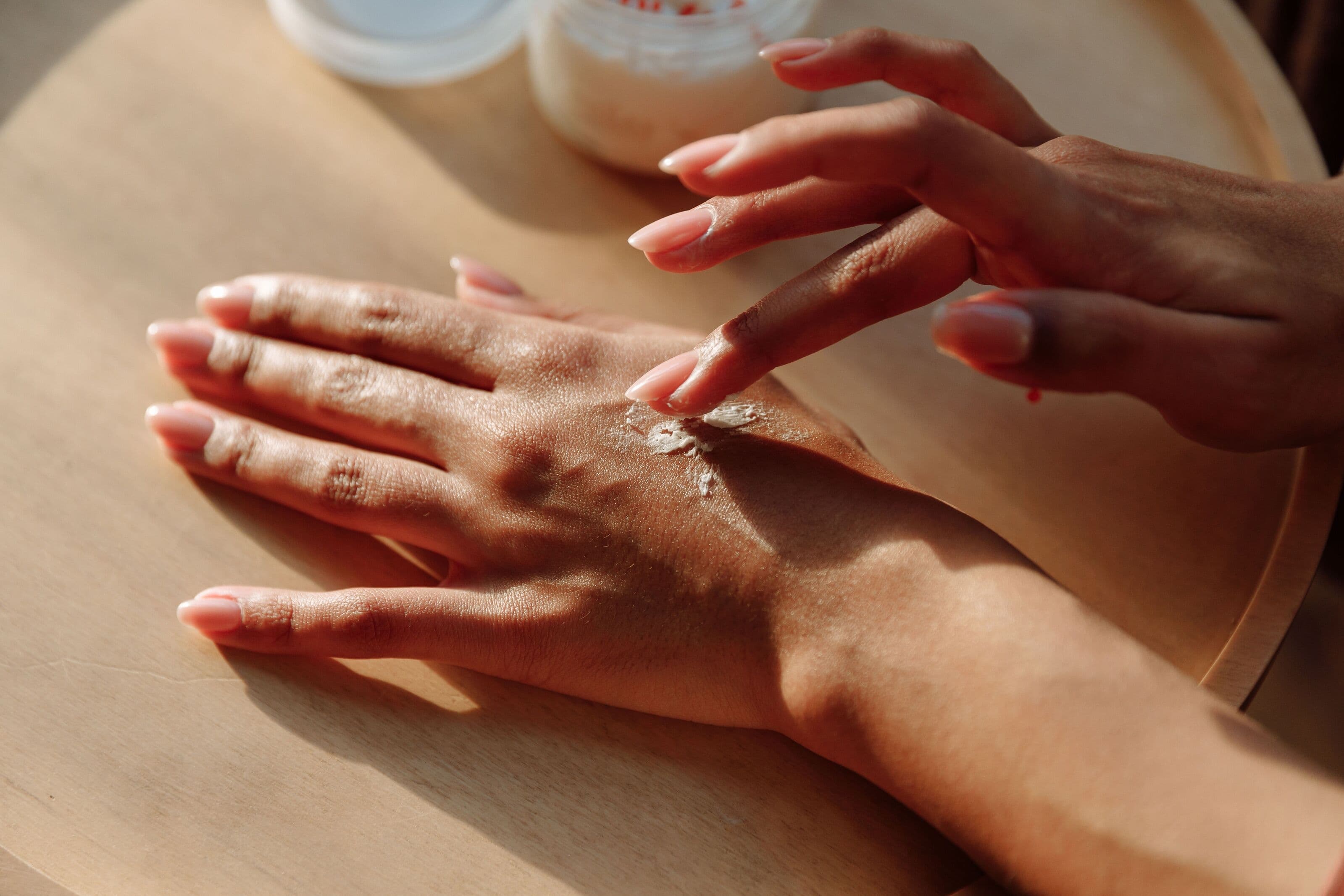
The two-finger rule. Squeeze sunscreen along the length of your index and middle fingers, then apply both finger-lengths to face + neck.
Most people apply 1/4 to 1/3 of that. SPF 50 applied at 1/4 the right thickness is roughly equivalent to SPF 12. That's why "I wear sunscreen and still get pigmented" is so common — the application thickness was wrong.
Pat (don't rub) into skin. Wait 60 seconds before makeup. Reapply every 2 hours of direct sun exposure (the window stretches to a full day if you're indoors).
What about under makeup?
The "sunscreen as a base" pattern works if you're applying enough. But realistically most makeup-wearers under-apply when sunscreen is the first layer.
Two safer options:
- SPF 50 cushion compact for touch-ups every 2 hours. Tap-on application reapplies sunscreen without disturbing makeup underneath.
- SPF 50 powder or stick for face only — easier to reapply through the day.
Either way, the morning layer needs to be a proper liquid sunscreen at the two-finger dose. Powders and sticks reapply, they don't substitute.
What we're working on
A clinical-grade mineral SPF stick for the selvé range — formulated for South Asian skin tones (no white cast), SPF 50, PA++++, water-resistant for swimming and sweating. It's in our Phase II roadmap; we'll announce dates as the formulation finalises.
Until then, look for any sunscreen that meets all three:
- SPF 50 (or higher)
- PA++++ (this is non-negotiable)
- No white cast on your skin tone (test before committing — try a sample)
Apply it at the two-finger dose. Reapply if you're outside. That's the protocol that matters.
The single most-impactful skincare habit anyone with Pakistani skin can build is daily SPF 50 PA++++. If you read no other post on this site, read this one — and then go check what's on the shelf in your bathroom.